

Ask someone who hasn't built before how they'd like their contract structured, and most will answer without much thought: fixed price. Agree a number, sign it, done.
Cost plus, if it gets mentioned at all, usually earns one sentence and a slight wince. Something like, "Isn't that the one where the builder can spend whatever they like and hand you the bill?"
We weren't always fans of it either. For a long time, we didn't fully understand how cost plus worked in practice, so we simply didn't offer it. It took running a number of cost plus jobs alongside fixed price ones to realise the fear around it has less to do with anything genuinely risky, and more to do with nobody explaining it properly.
Strip away the stigma of cost plus, and you'll find that the way we run the build is much the same. We estimate the job, quote the trades and manage the site the same way regardless of which contract you choose.
The big difference isn't how we build your project. It's how the contract deals with cost changes and who carries the risk when they happen.
Once you understand those two things, cost plus stops looking like the risky option and starts looking like just a different way of structuring your build.
Who actually suits a cost plus contract?
The first thing to understand with cost plus contracts is your eligibility.
In practice, cost plus generally suits cash clients because most traditional construction loans are structured around a fixed contract price. A lender needs to know how much it is lending against, and a cost-plus contract doesn't give them the same fixed number. Instead, the final cost can move as the actual costs of the build change.
That doesn't necessarily mean finance is impossible. Some lenders may offer other forms of lending, but the terms can be different, and the interest costs may be higher.
So if you're relying on a standard construction loan to fund your renovation or extension, a fixed price contract will generally be the more practical option.
If you have the funds available yourself, cost plus becomes something worth considering.
How does the billing actually work?
This is where you'll notice one of the biggest practical differences.
With a fixed price contract, your payments follow an agreed schedule of milestones. You know the contract price from the beginning, subject to any agreed variations, and you know roughly when each payment will fall due based on the project schedule.
With cost plus, you're paying for the actual costs of the build as they are incurred, along with the agreed builder's margin. Depending on the contract, invoices may be issued fortnightly or monthly.
That means one invoice might be relatively small, while the next could be much larger if higher costs have been incurred during that period.
You need to have enough cash available to cover those costs as they arise. You're not spreading one fixed contract sum neatly across a set payment schedule.
Fixed Price vs Cost Plus at a glance
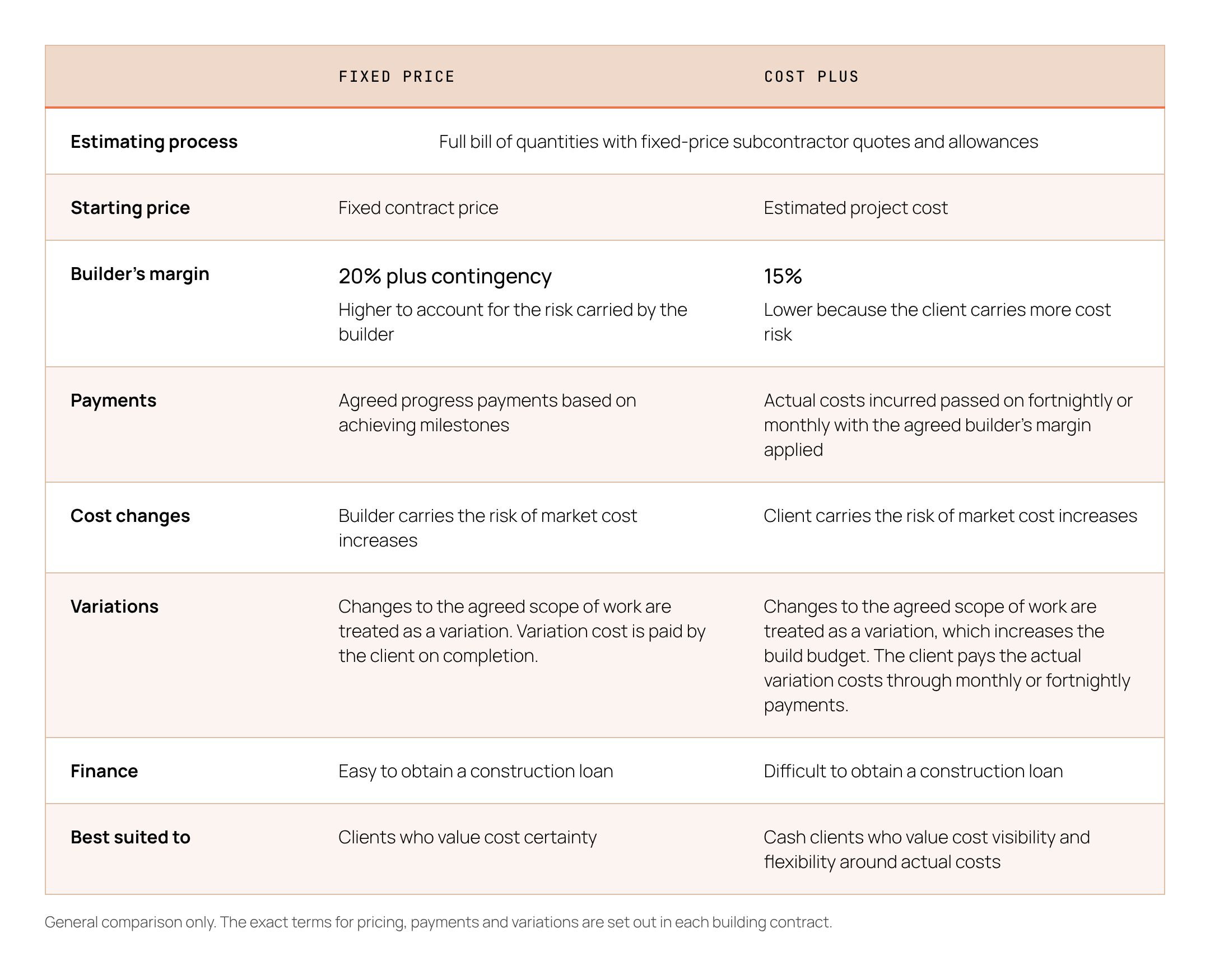
Doesn't cost plus just give the client more freedom to change their mind?
It can feel that way because you see every invoice and every dollar being spent on your behalf.
But visibility isn't the same as control, and it's worth being clear on that distinction before assuming cost plus means you can change your mind whenever you like.
Say you've selected a plain white wall tile for the bathroom, estimated at $30 a square metre. Partway through the build, you fall for a mosaic tile at $200 a square metre instead.
That's a variation, and it doesn't matter which contract you signed.
On a fixed price job, the change gets documented and added to the contract sum. A $1,000,000 build might become $1,005,000 after a $5,000 variation. That $5,000 variation will come to the client as an additional invoice payable on completion of that work.
On a cost-plus job, the same change still needs to be documented. The difference is that the cost for the change is documented as an update to the estimated cost to complete the project. The variation is still documented and signed, but the cost for it is only realised by the client in line with the fortnightly or monthly invoicing that occurs.
Cost plus doesn't buy more freedom to change your mind. It buys a clearer view of what each change actually costs.
So who actually wears the risk?
This is where the two contracts genuinely diverge.
The difference isn't a selection you changed. It's what happens when a cost changes because of the market.
Say the kitchen cabinetry is estimated at $100,000 early in the job.
If it ends up costing $90,000 once it's actually built and billed, a cost plus client pays $90,000, because that's what it cost.
A fixed price client still pays the original $100,000, because that's what was agreed.
Now flip it around.
If the cabinetry comes in at $105,000 instead, the cost plus client pays $105,000 plus the agreed margin.
The fixed price client still pays $100,000. The additional $5,000 sits with the builder as a cost overrun, and we manage it as part of delivering the project.
That's the fundamental trade-off.
With a fixed price, you pay more for certainty because we take on more of the risk.
With cost plus, you pay the actual cost, so you also take on more of the risk when those costs move.
Why is the margin different?
This is why the builder's margin isn't necessarily the same under both contracts.
On a fixed price project, we have to allow for the possibility that some costs will increase between estimating the job and actually purchasing the materials or engaging the trades. That risk needs to be accounted for in our pricing because we're the ones carrying it.
On cost plus, that same market risk generally sits with the client. There is less need to build the same level of contingency into the price, so the builder's margin can be lower.
At ZJ Building, our current guide is around 20% on fixed price contracts and 15% on cost plus contracts. These figures can change over time and should be treated as a guide rather than a locked figure.
For South Australian domestic building work, the legislation currently prescribes a maximum 15% additional amount for a cost-plus arrangement. The exact way this applies depends on the contract and the relevant legislation, so you should always check your own contract and seek legal advice if you're unsure.
What does that risk actually look like?
Take plasterboard as a simple example.
Imagine we're pricing 100 square metres at $8 a square metre. At the time we estimate the project, that gives us a $800 allowance.
Then, before the material is ordered, a shortage or price increase pushes the cost towards $12 a square metre.
On a fixed price job, that risk sits with us, subject to the terms of the contract. That's why a properly prepared fixed price quote needs to account for potential changes in material and trade costs.
On a cost plus job, there is less need for us to build that same market risk into the estimate. If the plasterboard costs $8 a square metre, that's what you pay. If it later costs $12 a square metre, the actual cost is reflected in what you pay.
That's the trade-off.
Fixed price gives you greater certainty around the final cost, while cost plus gives you greater visibility of the actual cost as the project progresses.
Which one is right for your project?
None of this makes cost plus the better option. It's simply an option worth understanding rather than ruling out on instinct.
Cost plus can make sense on larger, more detailed builds where many of the selections aren't locked in, where the scope may evolve during the project, or where you have the cash available and genuinely want to see what each part of the build costs.
It can also make sense when you don't want to pay for the same level of contingency that sits within a fixed price contract and are comfortable taking on more of the cost risk yourself.
Fixed price tends to make more sense when you want greater certainty around your overall project cost, have a construction loan, or simply prefer knowing what you're committing to before construction begins.
For smaller or more straightforward projects, fixed price will often be the simpler choice because there may not be enough cost uncertainty for a cost plus structure to offer much benefit.
What does ZJ Building usually recommend?
At ZJ Building, we mainly run fixed price contracts.
That's largely because most of our clients are financing their build and want the certainty of a fixed number and an agreed payment schedule.
But we also understand cost plus well enough to run it properly when it genuinely suits the project.
The important thing isn't choosing the contract that sounds better on paper. It's choosing the structure that matches your project, your finances and how comfortable you are with cost risk.
If you're a cash client weighing up how to structure your build, or you simply want to understand what you're actually choosing between before you sign anything, we'd be happy to talk it through with you.
Book a discovery call with our team and we can help you understand which approach may suit your project.


